Giving old T-shirts a second life: donate, reuse or recycle
A January clear-out often turns up shirts from past camps, missions and church events. Here is how to pass on the good ones, reuse the tired ones and recycle the rest, using UK council and charity guidance.
Most church families have a drawer of shirts with a story attached: a youth weekend, a holiday club, a sponsored walk, a mission trip with the date printed on the back. The new year is a natural moment to sort them out. Very few of them need to go in the bin.
This article draws on the reuse advice published by Worcestershire County Council, which is typical of what UK councils say, plus Save the Children's suggestions for its Christmas Jumper Day. Rules for collections differ from area to area, so check your own council's website for the details where you live.
Start with the wearable ones
Clothes in good condition are worth more as clothes than as anything else. The council advice is simple: donate them to a local charity shop, or sell them online. Before you bag them up:
- Wash them first. A charity shop has to be able to put an item straight on the rail.
- Check the print. A cracked or peeling print is fine for a work shirt or for painting the hall, but a shop may not be able to sell it. Our guide to caring for printed T-shirts explains why prints wear and how to slow it down.
- Think about who else could use it. A shirt from a church event can be passed to next year's helpers, a youth leader's spare box or a holiday club that needs shirts for new volunteers. If you are planning a group order, our guide to matching shirts for church groups suggests keeping a few spares in each size for exactly this reason.
Event shirts with names and dates
Shirts printed with a church's name, a person's name or a date are harder for a shop to sell, and you may not want them worn by strangers. They make good:
- sleep shirts, gardening or decorating shirts;
- a memory quilt or cushion cover, if someone in the family sews;
- cleaning cloths, once they are past wearing.
Worcestershire suggests worn-out clothes can be used as rags or washing cloths, and that light-coloured items that are stained or grubby can be tie-dyed to give them a new look.
Textile banks for the rest
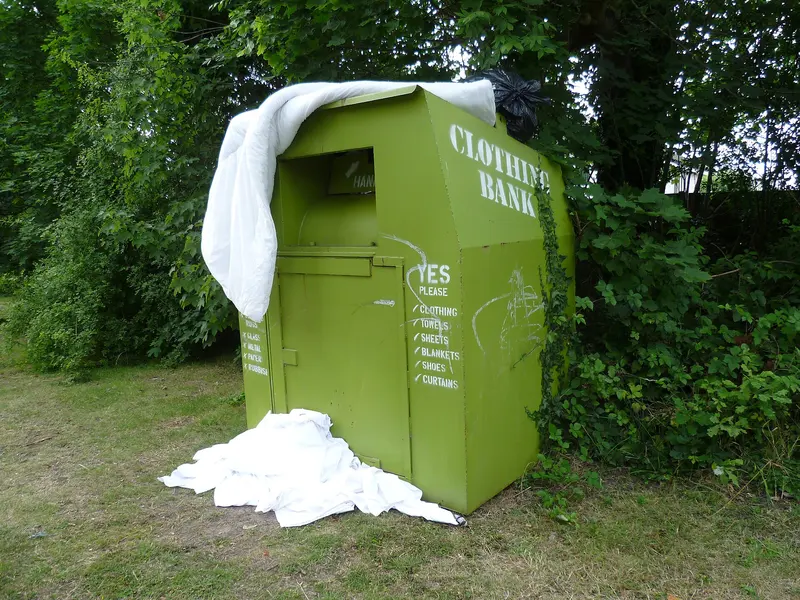
Clean clothing that is too worn to sell can still go to a textile bank, usually at a household recycling centre. The Worcestershire advice is to put small items in a plastic bag first and tie shoes together in pairs. It also says clean but worn-out clothing is accepted for use as industrial rags, but that you should not put clothing stained with paint or oil into the banks. Other councils have similar rules and some also collect textiles at the kerb, so look up your own.
Never leave bags outside a closed charity shop or next to a full textile bank. Donations left in the street often get wet or spoiled, and then they really are rubbish.
Charity collection bags through the door
Bags pushed through the letterbox asking for clothes are often genuine, but not always. The council advice is to check that the charity is registered before you fill one. GOV.UK explains that you can search the Charity Commission's register for free by a charity's name or number. It also notes that some charities are not on the register — those with an income below £5,000, and charities that are "excepted" or "exempt" — so a missing entry isn't proof of a problem on its own. If in doubt, give your bag to a charity shop you know instead.
Shops that take clothes back
Some retailers run take-back schemes and often give a voucher to spend in the store in return, according to the Worcestershire guidance. It's worth asking before you buy new shirts for the year ahead.
Before you buy more
The cheapest and greenest shirt is the one already in the cupboard. Save the Children's Christmas Jumper Day suggestions apply all year: decorate something you already own, visit a charity shop or swap with friends. A church "shirt swap" table after a service is an easy way to rehome children's shirts that have been outgrown long before they wore out.
When you do buy, the label tells you what the shirt is made of, which affects how long it lasts. Our guide to T-shirt fabrics and labels explains what the fibre names mean.
Shirt pictures are our illustrations — designs on Amazon vary.
This article is general information. Collection rules and what textile banks accept vary by council — your local authority's website has the details for your area.
Sources
- Worcestershire County Council — Reusing clothing and textiles
- GOV.UK — Find information about a charity
- Save the Children — Christmas Jumper Day FAQs
Checked 22 November 2026.
Published 22 November 2026.